Step down this path back into history to discover Burnhope Colliery, past Rifle Range, (old) Cricket Field Pavilion and Band Hut, between Ada Rainbow’s Carriage and the Hay Shed for Pit Ponies. Turning left up The Avenue. Ada Rainbow lived at No 1, children visited her to buy sweets when the Railway Carriage was condemned. Burnhope Colliery was on your right, water reservoir and chimney for underground boilers, gas works, Fortune and Annie Pits, stone sorting shed where coal was loaded onto wagons, pit yard with blacksmith, joiner, electrician, coal railway wagons repair shop, stores of pit props and other mining materials. Past the shunting yards where the ‘sets’ of coal wagons were marshalled ready to be hauled up the Wagon Way to Craghead and onto the Staiths on the Tyne. No evidence remains today of Burnhope Colliery.
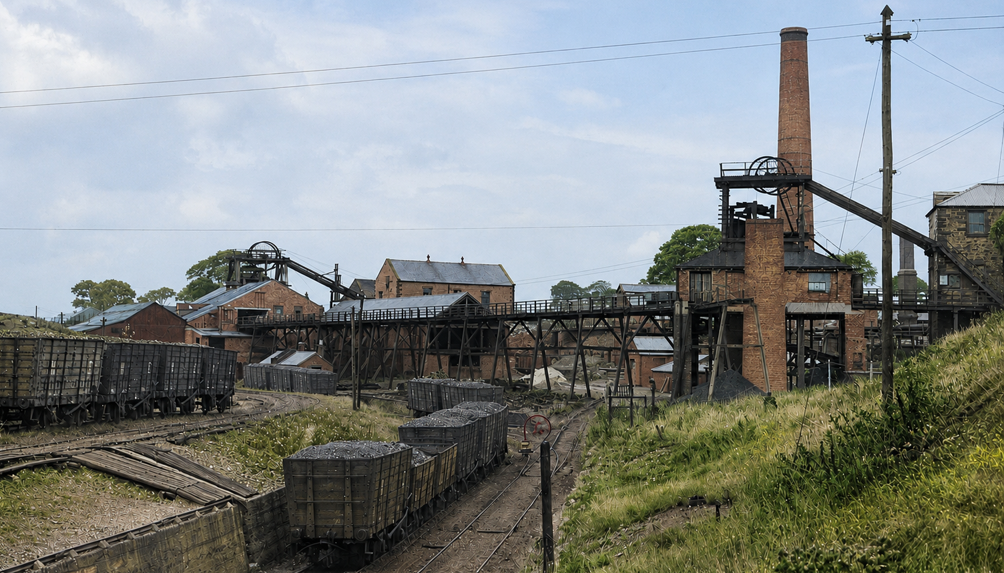
Ownership
William Hedley, who built Puffing Billy in 1814, leased 837 acres of land in Burnhope, for the purpose of mining coal, prior to his death in 1843. William’s four sons, Oswald, Thomas, William and George developed Burnhope Colliery until they gave up the lease in about 1860, probably to focus their resources on the far larger lease to the north that they were developing in partnership. Morrison South Pit was opened in 1869, and together with Louisa Pit (opened in 1759) and Hedley Pit, they were all operating by 1880 owned by Hedley and Bell, and were still being operated when Burnhope closed in 1949.
Mr. R. Fletcher partnered first by Mr. J. Towneley and then by Mr. J. Sowerby owned Burnhope Colliery for 20 years. Utrick Alexander Ritson, and his sons owned Burnhope Colliery from 1881 for over 50 years. Utrich Ritson died in 1932 and the sons retired in 1936.
The lease passed onto Halmshaw and Partners, who were Newcastle solicitors, and in 1939 passed onto Bearpark Coal and Coke Co. Ltd. In 1942 the new owners built an aerial ropeway, four and a half miles long, to carry Burnhope coal to the coke ovens in Bearpark. In 1947 the colliery became part of No. 6 area of the NCB Northern Division. Burnhope Colliery was the first mine closed by the NCB and ceased production on 22nd July 1949, despite delivering the target output.
Extracting coal
Fortune and Annie pits were located on the western escarpment of the Burnhope royalty. The upper coal seams, Main Coal, Five Quarter and Shield Row all outcropped to the west, south and north of the Whiteside Gill valley. Only the lower seams could be mined from the pits.
The Rabbit Warren Drifts (there appear to have been three) were opened in 1906 and operated until 1934. Branches were opened to Pheasant Drift in 1913, Cuckoo Drift in 1921 and Partridge Drift in 1927. All these drifts were closed before 1937. Polo Drift was opened in 1920 and worked for four years supplying coal to Malton Colliery. Robin Drift was opened in 1930 and the first Shield Row Drift (to the north under Church Row) was opened in the early 1940’s and both closed when the second Shield Row Drift was opened under Fell Row in 1943, and closed in 1948. The drift was close to the surface, so residents in Fell Row could hear the tubs rumbling underground.
At its peak, in the year 1910, Burnhope Colliery employed 1,244 men and delivered 306,910 tons of coal. The colliery owners were prosperous until the early 1920’s when the sales price of coal fell rapidly. This caused strikes when the colliery owners reduced wages, and the prosperity never returned. In the year 1945 Burnhope Colliery employed 697 men and delivered 123,529 tons of coal.
Working in a Drift Mine
Thomas Johnson worked at Burnhope Colliery in the early 1920’s, first in the group of drifts known as ‘The Warren’ and then in the office arranging, among other matters, the shipping of coal up the Wagon Way. He describes the mine manager, Jos Snaith, as: “a very kind hearted manager with a little speech difficulty, always willing to listen with concern for workers and their families.”
Burnhope Colliery worked coal two dayshifts with a night shift removing stone around the face. There were no automated coal cutting machines, all coal was hewed by hand using the ‘Bord and Pillar’ system that left 22 square yard pillars of coal. Joseph Snaith reports that pneumatic ‘windy’ picks were first trialed on 24th October 1934 and eight were in use in the Robin Drift, with newly agreed pay rates, on 1st February 1935.
Thomas recalls ‘cavilling’ when the ‘hewers’ drew lots to determine their working position for a three month period. The ‘hewers’ who worked the same position on the ‘fore’ and ‘aft’ shifts shared their earnings. They were paid by results with a minimum wage to protect workers with difficult ‘stents’. When a ‘hewer’ received an empty tub, he would attach one of his tokens to an iron loop on the inside bottom of the tub. This was removed from the tub when it was emptied and put on a hook. At the end of the day a manager and the ‘check weighman’, representing the union, would count the tokens and pass the count to the office, so that the wage sheets could be made up every fortnight.
John Harland worked in Lanchester Drift for many years. John recalls the method used to remove coal in narrow seams: “The hewer on the ‘fore’ shift would cut a tongue out of the face about a yard deep. The hewer on the ‘aft’ shift would cut the sides off the tongue to make a straight end. ‘deadwork’ was undertaken by the night shift using explosives to break up the stone above and below the removed coal, and ‘stonemen ploated the canch’ up to the coal face, by clearing the stone and packing it down the sides and fitting pit props to make the roof secure.”
Thomas recalls: “These workings were still not as high as the five foot tall main ways needed to give the pony access” and that “The hewer lay on his side to excavate the coal.”
John remembers: “Putting his tub to the flat and how his bent back scraped the roof, knocking off the scabs over his spine, making them bleed, and how the wet, cold canvas ventilator flaps invariably scraped the sores.”
Thomas worked as a driver with a pony: “A train of empty tubs would arrive at the ‘landing’, which was a sort of railway station just outside the drift. The drivers would each take a set of about six tubs, hook on the pony’s limbers and drive them to the ‘flat’, a minor station inside the drift. The putter would take a tub, attach his disc and push it to the hewer, who would fill the tub with coal. The putter would push the filled tub back to the ‘flat’. The driver took the filled tubs to the landing and when there were enough tubs for a train, he would connect the tubs up to the ropes and signal them as ready.”
Colin Mountford describes the Warren ‘hauler’ as a standing engine built near Annie Pit and supplied with steam from the central boiler house. This operated two drums carrying ‘main’ and ‘tail’ haulage ropes. The tail rope would go out to the drift and round a return wheel. The main rope would be connected to the front of the train of 25 to 30 tubs and the tail rope to the back of the train.
The standing engine would haul the train about a mile up to the ‘bank’ (mine head) beside and above the screens at Annie Pit. Thomas Johnson describes the tubs then being turned over by a ‘kick-ups’ machine to tip the coal onto the screens, worked by 2 men, and the coal passed onto an endless belt, where boys removed the stones, and then down to the waiting empty railway wagons. When there were sufficient empty tubs to form a train, the empties would be hauled back to the ‘landing’.
Joseph Snaith records installing a saw mill in Stand-Against All plantation in 1917. The plantation was an essential part of the mining process. One of Thomas’ tasks was to take a ‘tram’ to the ‘offtakes’ (an outdoors rail junction) for a load of timber props. At the end of the shift, Thomas describes: “Taking his pony out of the drift and enjoying an open air ride to the wash in the field, where he removed the worst of the dirt, and another ride to the stable, where the ponies were groomed, fed and checked for fitness for the next day.”
Thomas recalls this being in ‘another drift.’ (There was an old drift near Annie Pit.) Joseph Snaith records building a brick and slate roof stables for 32 ponies in 1924.
John Harland recalls that the ventilation in drift mines was good enough not to need safety lamps. But not that good, as Thomas recalls using naked lights that went out if they were placed on the ground, so he kept the light near the roof at all times. Thomas also recalls being present when gas was lit deliberately: “it burned fitfully over a pool of water.” So gas was present in small quantities and there was a lack of oxygen. Canvas doors were hung from the roof to control ventilation and moved aside by the tubs.
Colin E. Mountford wrote two 28 page booklets if the above has wetted your interest. Burnhope Colliery and Village Part 1 and Part 2.