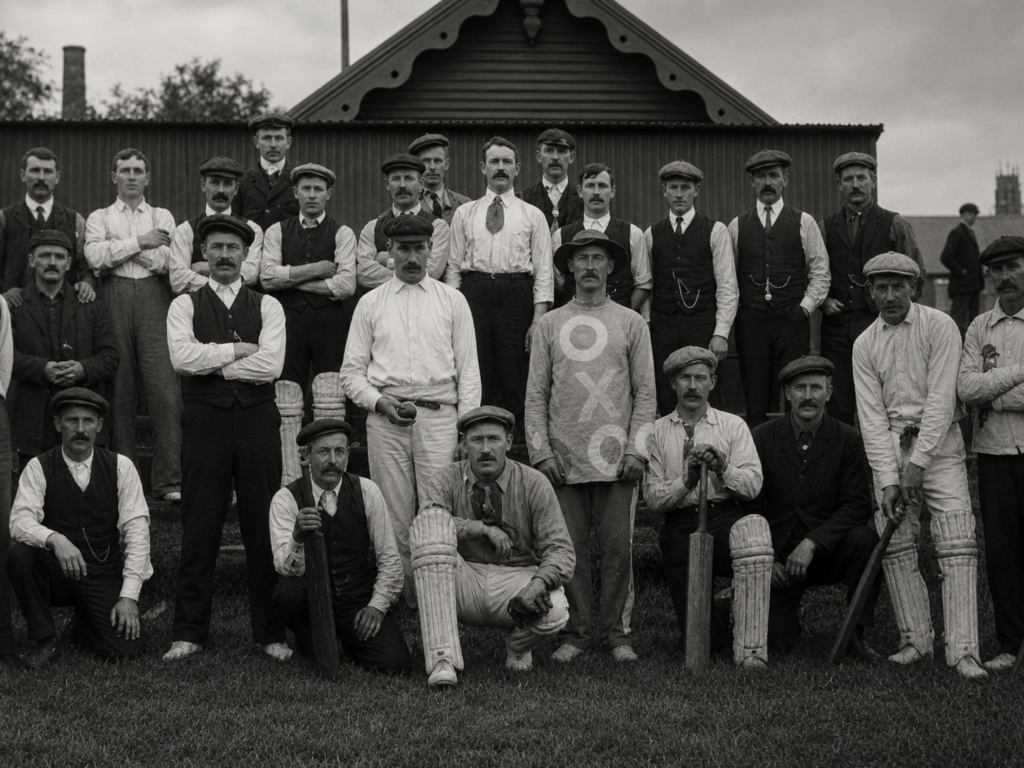
Utrick Ritson, and his sons owned Burnhope Colliery from 1881 for over 50 years. Joseph Snaith was mine manager from 1914 to 1936. His record of expenditure from 1881 to 1937 shows the Ritson’s investing as much money in the village as they did in the mine workings.
After extending the colliery school in 1883, the next village expense was the cricket field and wooden pavilion. Joseph Snaith’s journal records for 1887 “Wall around cricket field material and labour £13-18-0”. This 3 metre high wall has stood solidly for 140 years, a fitting tribute to the excellent craftsmanship. There is no record of the work levelling the cricket field or building a wooden cricket pavilion. This is shown on the Ordnance Survey map to be along the side of the road that now leads to Fair View, across Gordon Hockaday’s track. In 1905 the Rifle Range would be built between the Old Cricket Pavilion and Holmside Lane, and in 1921 the Band Hut erected on the other side.
The cricket field is the only one of the many amenities, Utrick Ritson gave the village, to survive to the present day, and still is a thriving cricket club. The new brick pavilion was built against the end of the Co-Op in 1913 ready for the summer season. Thomas Johnson (b. 1906) recalls, “there was help at the cricket pitch with a very nice pavilion with changing rooms with a balcony and large eating room upstairs. Even at the village school there was help for cricket. There was a local league for schoolboys and I remember the Burnhope team being resplendent with complete new whites and cricket caps from the colliery owners. I have a delightful recollection of an incident when a friendly match had been arranged with a Ritson eleven. I walked along the path outside the ground towards the entrance gate I stopped to listen to sounds I had not heard before. It was only the chatter of children, but it was lovely to hear above me on the balcony, the outpourings of children who had been educated to speak correctly! It sounded beautiful after our ordinary uncultured speech.”
The Old Cricket Pavilion became shops. Joseph Snaith records 25th January 1922, “Fire in Miss Brown’s shop in old cricket pavilion, both shops were burnt out, Hobkirk newsagent salvaging a little of his stock”. Fortunately the Rifle Range and Band Hut were not connected and survived the fire that destroyed the Old Cricket Pavilion.
Miss Brown’s shop was first re-accommodated in the Rifle Range and she continued to trade for more than a decade. Miss Eva Brown came from a highly regarded family and cut ‘quite a dash’ as she swept through the village. It was obvious she was the perfect choice for the bachelor Dr James Grant. They were married at 2pm on Saturday November 17th 1934, when a call came that there had been an accident in the colliery. Dr. Grant was called down the mine in his wedding suit to attend Robert Barrass who had suffered a serious accident in the Brockwell seam. Dr Grant saw him to the surface before returning to take his anxious bride to the end house on West Terrace, where he had held his surgery since becoming the Colliery Doctor on July 24th 1930.
After this it was said: “the miners would never have anything bad said about Dr. Grant.”
This occurred shortly after a public meeting called by Joseph Snaith “to consider the conduct of Dr. Grant where he was told to mend his ways”, and a second meeting on 14th July 1935 when he was sacked as the Colliery Doctor. James Grant remained the Burnhope Doctor for a further 20 years. There are living memories of his care and collecting his fees.