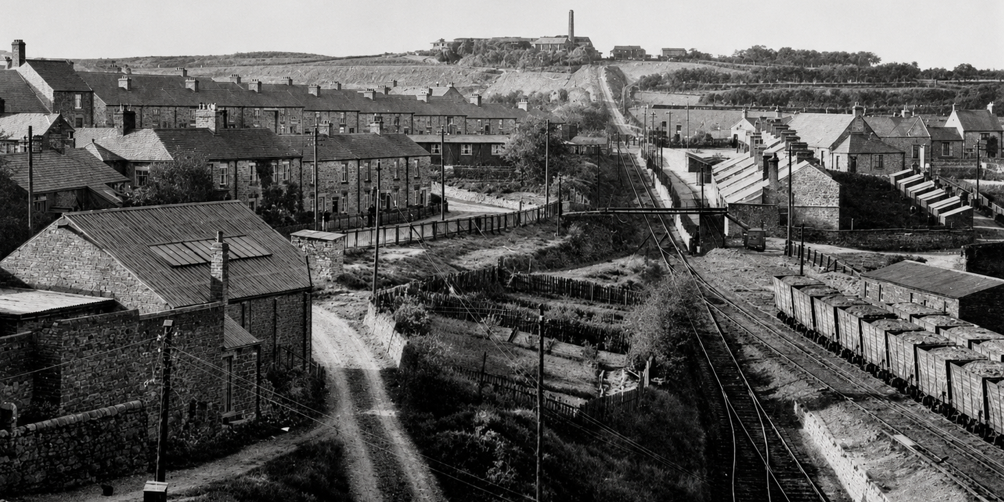
In the 1920s the centre of the village was where the Wagon Way (now just a path) crossed Holmside Lane, the huge Burnhope Park stretching a long way to the left of the War Memorial, the roof of the Colliery School seen across Holmside Lane.
Birth of a village
In the 1841 Census there were 189 people in 36 households in the parish of Burnhope, 9 farmers, 17 labourers, shepherd, schoolmaster, weaver, cartwright, blacksmith, Langley Estate bailiff and 4 of independent means.
William Hedley, who built Puffing Billy in 1814, leased 837 acres of land in Burnhope, for the purpose of mining coal, prior to his death in 1843. William’s four sons, Oswald, Thomas, William and George not only had to blast a 3 metre by 3 metre shaft 126 metres deep, they also h
| West Stone Row |
| Cross Row |
ad to build an embankment half a mile long to give a 1 in 25 constant incline and lay a railway line over 2 miles long to Craghead. The Hedley brothers built 55 wooden houses to house the development workers, probably in 1844 to form East and West Wood Rows. To house the miners and their families, the Hedley brothers built a further 125 two & three room houses using stone extracted when sinking the mine shaft, prior to 1855. Church Row and Fell Cottages, West Stone, Cross, Office & Fell Rows.
The Hedley brothers built Burnhope Colliery Inn before 1851 and School in 1855. Funds for building St John’s church were raised by money deducted from the pay of the Burnhope miners and the church completed in 1865. Wesleyan Methodists built a chapel next to the Colliery School in 1880.
When the Hedley brothers sold the lease in about 1860, the new owners blasted several more pits but did not invest in the housing at all. In 1873 the Newcastle Weekly Chronicle described West Stone Row, Cross Row, Office Row and Fell Row in Burnhope:
“As forlorn and desolate as a penal settlement… built in a sort of triangular square enclosing a
howling wilderness. Anyone would howl if he were doomed to be hemmed in by such rackety, filthy, tumble down old pig sties. They were wretched hovels, with several slates to each roof, but makes little odds as the rain pours in… there were only a handful of ash closets for a village of 500 people… the space surrounded by the pit rows is one large pestilential midden: the corners serve the purposes of nature, and the unmentionable nastiness is trodden into the houses.”
The Colliery owners built the headmaster’s residence in 1874 and extended the school on 1875 and 1876.
Utrick Ritson purchased Burnhope Colliery in 1881, extending the school again in 1883 and 1888, adding heating in 1891 and building a cricket field in 1887. Utrick was a methodist, he allowed the primitive methodists to hold their meetings in the company office, until the miners built the Primitive Methodist Chapel in 1888. George Bell was listed as a Fruitier in the 1891 census, Henry Knowles, his stepson listed in the 1894 business directory as post master.
The mine manager’s journal lists Utrick Ritson repairing the existing stone houses nearly every year from 1890 to 1903. The village started to move up the hill when Utrick Ritson built 30 new houses on Pavilion Terrace 1893 and shops beside Burnhope Inn 1894, 44 flats in brick on West Terrace 1900, 10 houses on The Avenue 1904 and 32 houses on Whitehouse Terrace 1907. When Utrick Ritson built the Memorial and Burnhope Part in 1920, erected the Nurse’s Hut and Comrades Hut in what had been the (1873) pestilential midden in 1921, the centre of the village had already moved up the hill.