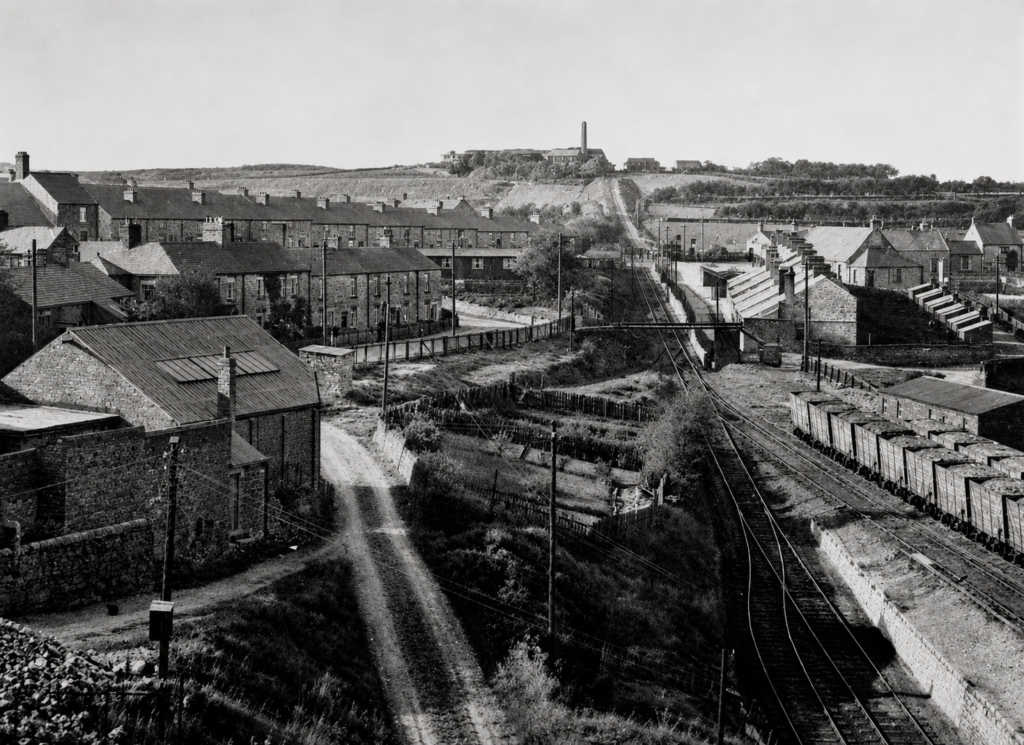
As it was isolated on a hill top, transporting coal from Burnhope Colliery presented a challenge to the Hedley brothers. An inclined railway already carried coal from Craghead to the Stanhope and Tyne Railway for onward shipment to the shipping staiths on the Tyne at South Shields. Between Burnhope and Craghead was a ridge 250 metres high, the incline too steep for a locomotive.
The Hedleys built the embankment that still exists today, creating a steady incline rising from Holmside Lane to the top of the ridge, where the Hedleys installed a stationary engine. Steel cables were used to drag full wagons up from Burnhope Colliery, the engine then restraining the wagons as they rolled down the slope to Craghead. The steam engine drove two drums on a single shaft. The Burnhope cable came from the bottom of the smaller drum and the Craghead cable came from the top of the larger drum. The cable would run (loose) between the rails (in a channel across Holmside Lane) and be attached to the front of the set of wagons.
When enough full wagons (‘fulls’) were ready to form a set, the set-rider ‘rapped a bell code’ and jumped onto the front wagon. Bank Top engineman pulled the set until the cable reached the 1st mark on his drum. The set-rider, who was responsible for safety, stepped off, collected a tripod with two red flags from the cabin beside the Holmside Lane crossing and placed it on the village side of the road. He again ‘rapped a bell code’, and the Bank Top engineman pulled the set until the 2nd mark on his drum. The set-rider cleared the road, ‘rapped a bell code’ and jumped onto the back wagon.
As the set of ‘fulls’ approached Bank Top the engineman stopped the set when the cable reached the 3rd mark on the drum. The set-rider stepped off and after the last wagon had passed over, reset the safety chock which was designed to stop a runaway set from travelling back down to Burnhope unattended. He then walked along the set of wagons and jumped onto the front wagon. The engineman restarted pulling the set, when it had picked up speed and the rope slackened, the set-rider stepped off, unhooked the Burnhope rope and jumped back onto the first wagon. The downwards slope of the hollow helped by the momentum of the set of wagons sent the ‘fulls’ over the Craghead rise. The set-rider used the brake on the front wagon to stop the set just before it reached the safety chock across the track on the Craghead side. The set-rider walked to the back of the set of wagons and connected the Craghead rope to the back wagon. He then walked back to the front, removed the safety chock, stepped onto the front wagon, released the brake and the set started to roll down the hill. The set of ‘fulls’ then travelled down to Craghead with the speed restrained by the engine man applying the brakes to the Craghead drum. Empties would be returned by the reverse process.
Railway wagons moving unattended over a public road on an unfenced railway line was an unsafe working practice. On the 3rd February 1912 a set of ‘fulls’ collided with Walter Willson’s grocery delivery cart. On the 11th May 1937 the Diamond bus stalled on Holmside Lane crossing the line. The driver, conductor and inspector were unable to push it off and the bus was hit by a set of ‘empties’. The procedure, designed to avoid these accidents, did not work.
Of the hundred fatalities at Burnhope Colliery, five were killed on the Wagon Way, Matthew Stafford, a colliery inspector in 1867, William Siddens run over by empties 22nd March 1869, George Willey, a farmer in 1899, John Logan run over by empties 23rd Feb 1921, John Hockaday crushed between wagons and Bank Top Engine House 14th Nov 1945.