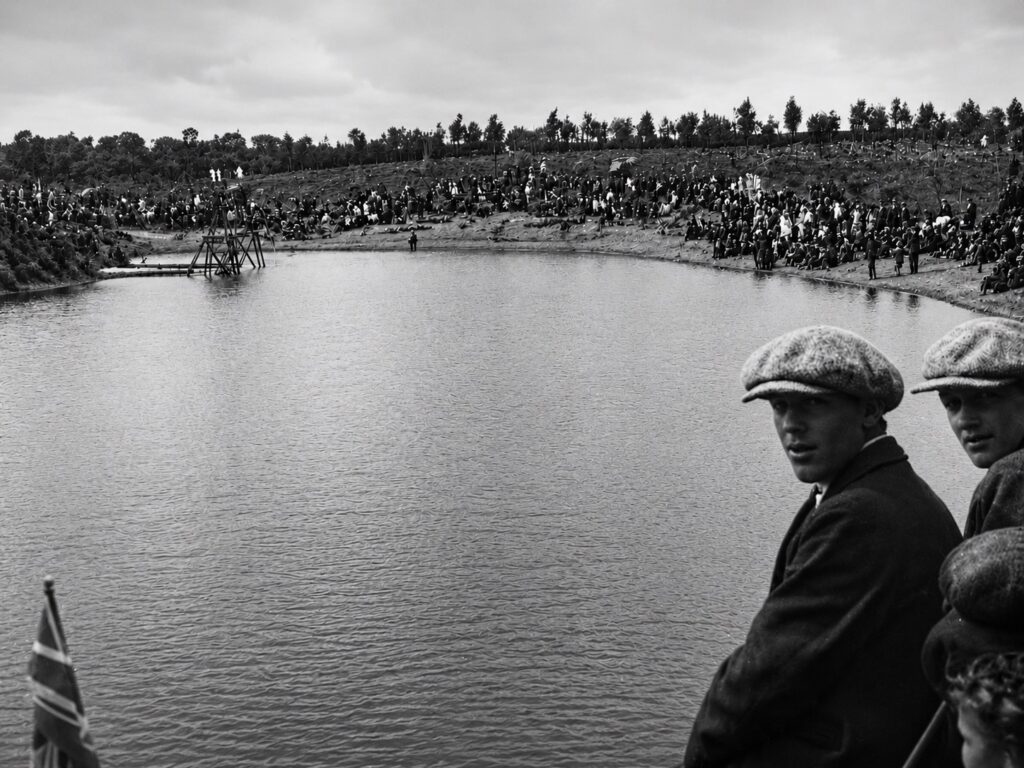
Thomas Johnson (b. 1906) records in his memoirs. “After the 1914-18 war ended the colliery owners thoughtfully gave a job to Captain Wharrier as Welfare Officer. It was at strike times that ‘Bob” Wharrier was very busy arranging competitions of all sorts with good prizes, making a good effort to get everybody involved. The colliery owners U.A. Ritson and Sons, who had paid for everything also helped in another way. During a strike in 1919 they offered to give an area with an old reservoir to the village as a park, to supply trees and everything. All their striking miners were offered a wage to work at making the park, which was not black legging, of course, but a very good chance to avoid hardship, making a park for the enjoyment of the village families.”
From the Northern Echo – 6/9/1920
“Park for Burnhope, colliery owners handsome gift to the village. At Burnhope on Saturday Mr Utrick Ritson, head of the firm of U.A. Ritson and Sons, owners of Burnhope Colliery, unveiled a war memorial and opened the gates of the public park, which the owners had presented to the village.”
The gates to the park are wrought iron gates at the rear of the war memorial, bearing above, the words, “To The Glorious Dead”.
After the ceremony, the colliery owners provided tea for 850 children and for all wives, widows and mothers of the fallen and disabled men, and the aged people of the village. Afterwards sports were organised for the children.
People would not see any notices to “keep off the grass” in the park, which was intended for the use of the old and young.
Families learnt to swim, fished, sailed boats and used the diving board provided. It was a very busy place on sunny Sunday afternoons.
Many Burnhope residents remember the Park Superintendent as being very strict. Others remember swings, a see-saw and a shelter of glass, wood and concrete.
A company of the Royal Army Service Corps was billeted in Burnhope, arriving with about a dozen Bedford lorries. The perimeter of the park behind the War Memorial was lined with trees and a small road encircled the lake. Trees were cut down at measured intervals to provide parking spaces for the lorries.
Eventually Burnhope Park was sold off by the National Coal Board (NCB) to Mr. Knowles, who kept the shop at Ivy Cottage.