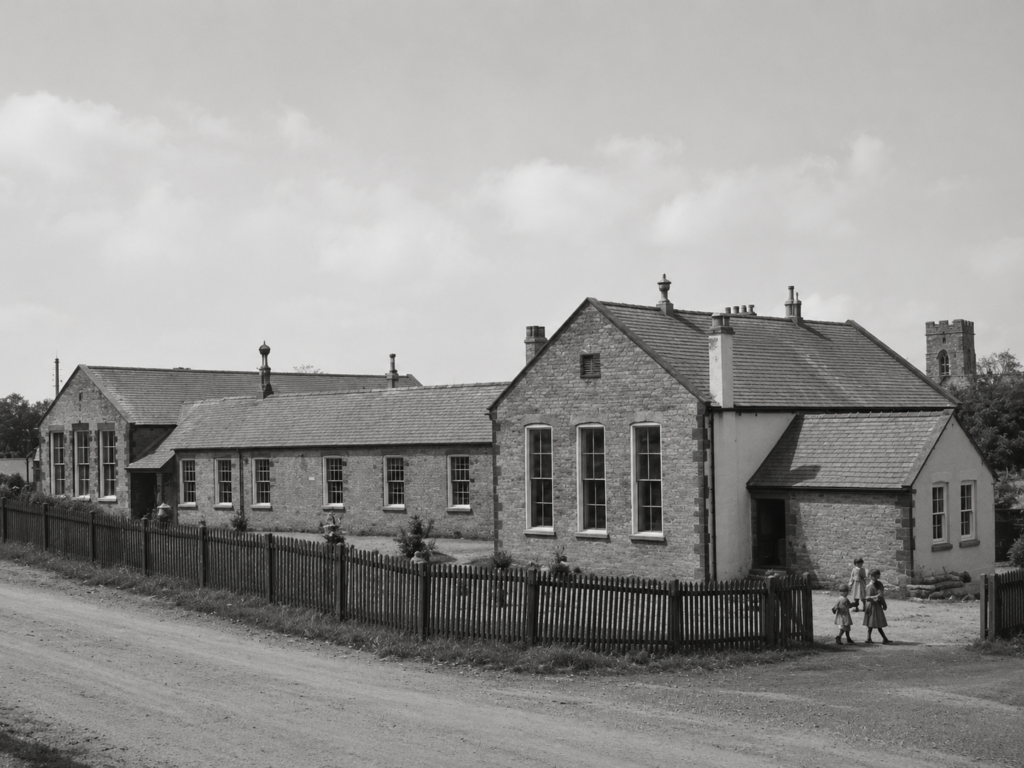
Before mining began in the area there was no settlement as such, merely outlying farms and agricultural cottages.
William Hedley, the founder of Burnhope Colliery, needed workers and they needed houses for their families. Rows of workers’ cottages were constructed at the bottom of the hill. With the influx of families, it was obvious a school was needed.
The foundation of Burnhope Colliery School was laid in 1854 by the colliery owner and the school opened in 1855. The colliery manager was also the school manager.
Located in the centre of the old village, the school originally consisted of just one classroom and the school house, with all ages being taught in one room, which was heated by two coal fires, one at each end of the room.
Several enlargements were made to the school premises over the following years. The headmaster’s residence was constructed in 1874, with further extensions in 1875. In 1876 a new wing was built, then again the school was enlarged in 1883, and in 1888 a further new wing was built. Heating was installed in 1891.
In January 1874, Mr. Robert Mordue became headmaster at the school. He began keeping a log book. His first comment was, “found the children very backward, probably owing to the fact that the school had been without a master for some months”.
There were 122 children at the school and Mr. Mordue was the only teacher. He was assisted by pupil teachers, who were older, intelligent pupils who took charge of a class in lieu of a teacher, but visiting teachers would often help out by teaching a lesson.
At the end of the year, an assistant teacher was appointed to join Mr. Mordue.
Parents paid for their children’s education, as well as school copy books, although a grant could be obtained for the very poor.
At the end of January 1875 the school fee was increased by one penny per week from 2d to 3d, and 3d to 4d. By the end of February, only 50 children attended the school due to the Miners’ Union telling parents to withdraw children due to the increase in school fees. A 10% fine was threatened to any member of the union who sent his child until the old fee was restored.
In 1877 there was a notable increase in attendance, which was probably as a result of the introduction of the Compulsory Clause of Education Act by the Branch of Guardians, and later that year attendance increased by 100 in one week following a visit from a School Attendance Officer.
The logbook records that weather affected school attendance, but there were various other excuses, such as: “looking after the baby, minding the home, gathering hay, and no boots!”
Sickness such as typhoid, cholera, tuberculosis, whooping cough, eczema, impetigo, scabies, measles, mumps, chickenpox and the influenza epidemic of 1918 also affected the village. By 1914 the village had its own nurse, physician and surgeon, and from 1920 a school nurse. The nurse was housed in an ex Army hut in the triangle that had been described as a ‘pestilential midden’ in 1873 by the Newcastle Weekly Chronicle.
The inspection of the children at the school in August 1926 by the County Medical Officer revealed, “of 318 children in the Junior Mixed Department, 27 had no boots on and 80 were wearing boots that were “very bad”, while of the 115 in the Infant Department, 3 were off school as they had no boots and 53 were very bad.” Two days later Colonel Ritson gave £25 to the school boots fund.
Over the years there were several reorganisations of the school.
In 1902 the Infant Department became Burnhope Colliery Infant School, with Miss Tweedle as Headmistress.
The Mixed School became Burnhope Colliery Mixed School, for both juniors and seniors, with Mr. Burgess appointed as Headmaster.
In 1906, Durham County Council took over responsibility for both schools and, from 1907, the schools became Burnhope Council Junior Mixed School.
Isabella Jackson was appointed Headmistress of the Infant School in 1919, aged 26, and was believed to be the youngest headmistress in County Durham.
In the early 1930s, the County Council decided school-age children from 5–14 years of age had to be reorganised into Primary and Secondary Schools. From the age of 11 brighter children transferred to the Technical Institute in Consett or Annfield Plain and the remainder stayed in Burnhope at the new school, opened in June 1932, in Langley Avenue.
In 1966, because of falling numbers, the Colliery School closed, with all the primary-age children being transferred to the school on Langley Avenue.
Harry Baron attended the “bottom school”, starting his school days in the early 1940s. He remembers there were separate entrances for girls and boys, playgrounds were separated by a high wall and toilets were outside in the yard. He recalls they were very happy days.
The classrooms were heated by coal fires, and when the weather was particularly cold all the children were served with cups of hot cocoa at lunchtime. Harry hated cocoa then and never learned to like it.
Discipline was very strict in school and respect for elders was instilled into all pupils. Teachers used to throw blackboard rubbers, and used the cane as a form of punishment. TO ADD “The Burnhope Lad” a poem a friend of his wrote on Christian Garcia-Miralles’ Grandfather Ralph Sanderson’s retirement from British Coal.
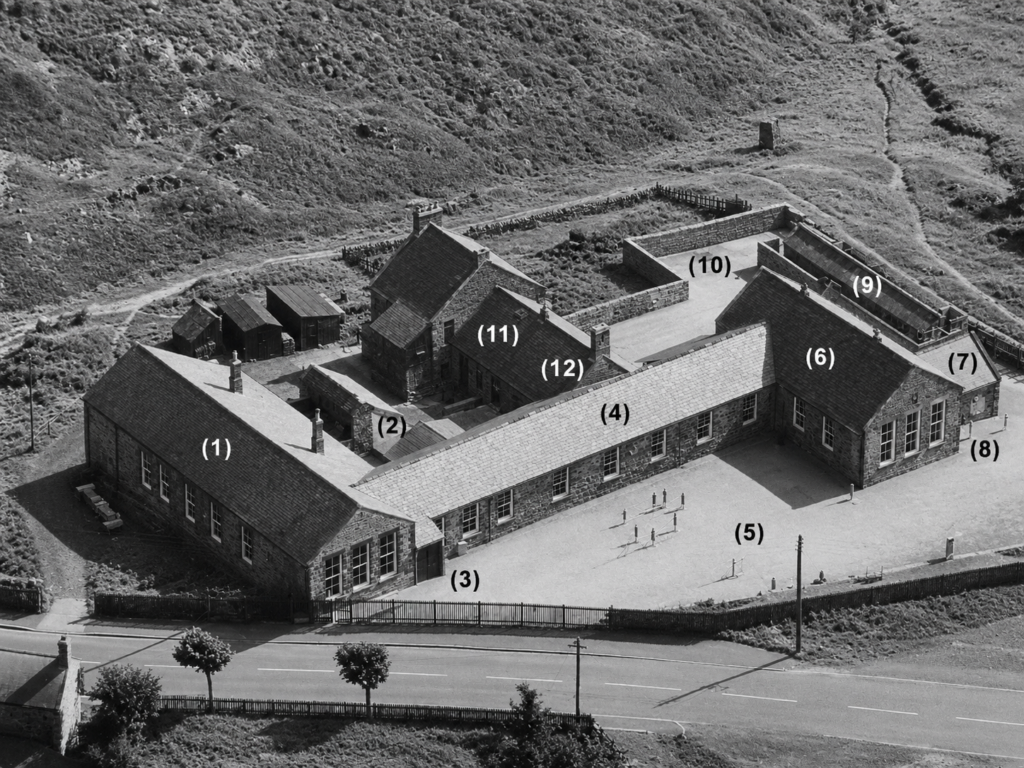
TO ADD the uses of each room from Mountford Book 2